When a Cow Learns to Move: What Generative AI Can Change About Storytelling
Alma has a film trailer now. This is not a sentence I expected to write when I first started creating stories about a brown cow living in Barcelona.
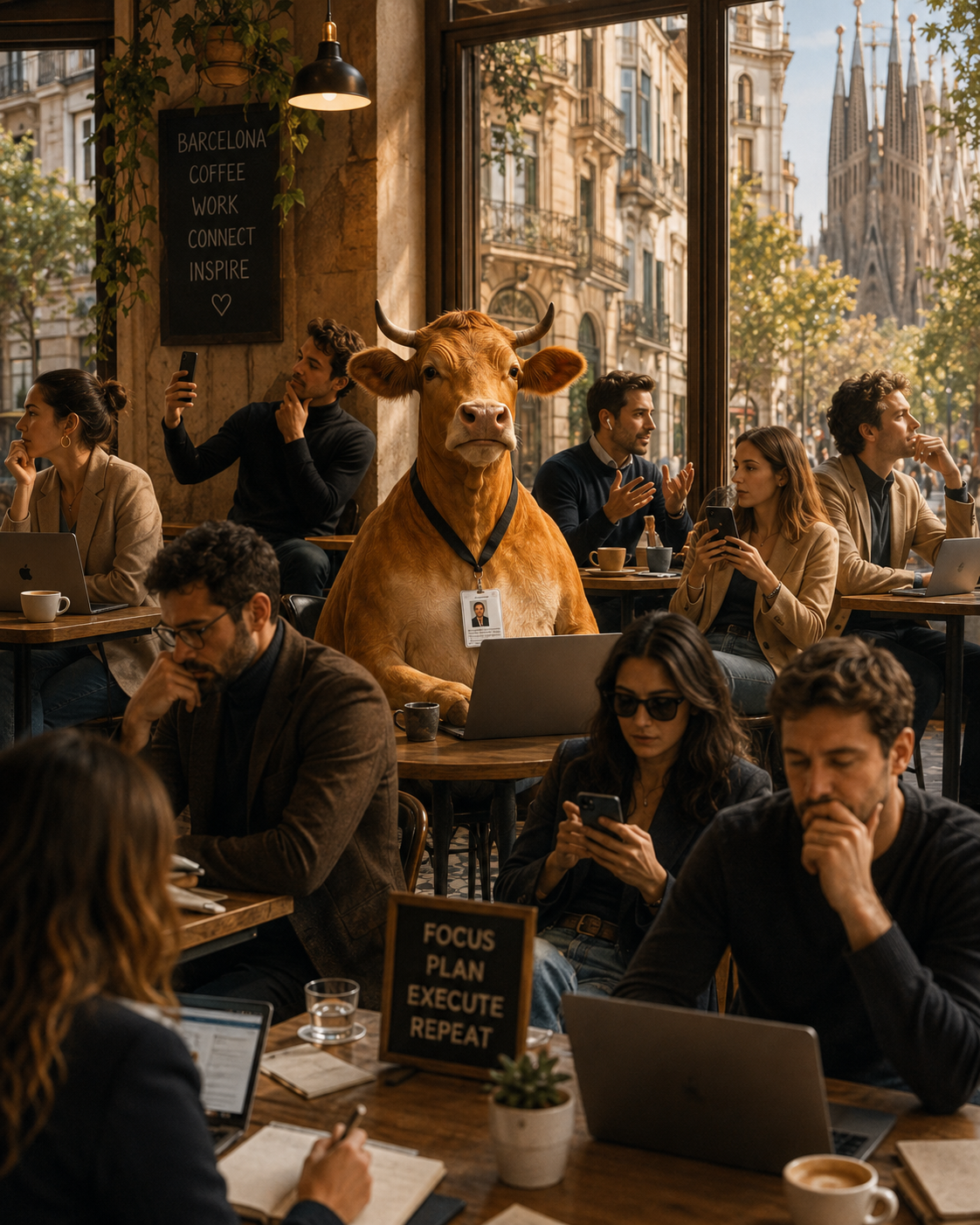
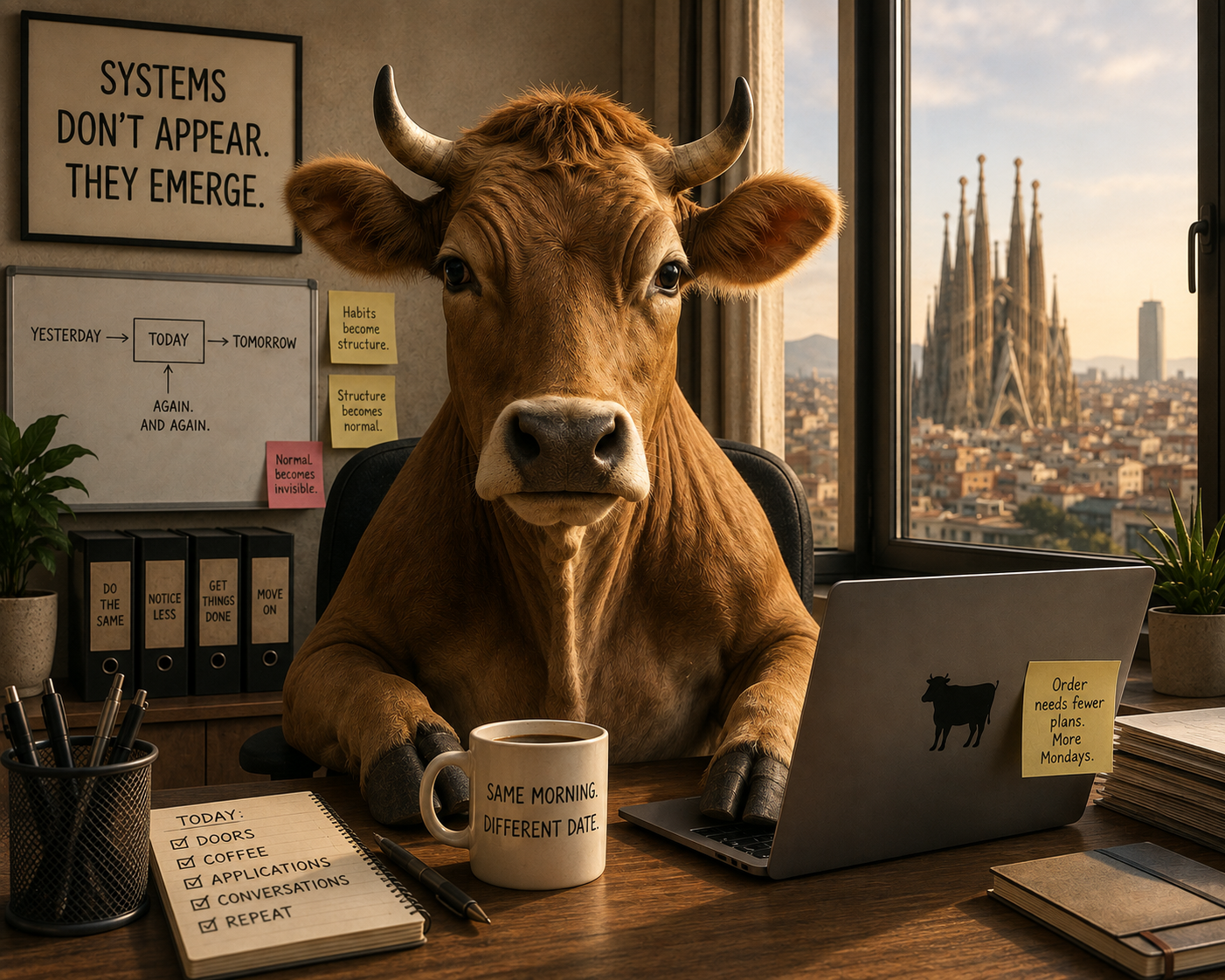
Alma began in words. She observes people and has her own thoughts about work, productivity, freedom and some of the other strange things we have decided to organize our lives around. Then came images. Alma sat in cafés, went to the beach and wandered around Barcelona. At some point, I started wondering what else I could do with the world I had created. More specifically, I wanted to know what would happen if Alma moved.
So I started experimenting with Gemini. There was no sophisticated production setup behind it, and I wasn't trying to become a filmmaker. Over roughly six months, I kept describing Alma, writing prompts, changing them, creating scenes and trying to get closer to the character and the world I could see in my head.
It worked surprisingly well.
Not always.
Alma is brown. I know this because I created her. Gemini occasionally had a different interpretation of the matter. Sometimes she was white. On other occasions, she looked suspiciously like a horse. Graphics appeared where they weren't supposed to be, and scenes that seemed perfectly clear when I described them developed ideas of their own once they became video.
Generative AI can do remarkable things.
Keeping the same cow brown throughout a film remains a work in progress.
How I made the Kuh Alma trailer with generative AI
The technical setup was much less impressive than the finished term AI filmmaking might suggest. I used Gemini. I wrote what should happen, described what I wanted to see in each scene and generated different clips. Then came a fairly large part of the actual work: watching them, deciding what belonged in Alma's world, rejecting what didn't, changing the prompt and trying again.
I also created the music with Gemini. I described the direction I wanted it to take, whether there should be vocals or not, and experimented until I had something that worked with the images. Then I took the clips into iMovie, put them in sequence and added the soundtrack.
For the Kuh Alma trailer, I used Gemini to turn my scene descriptions into video clips and to create the music. I then edited the selected clips and soundtrack in iMovie. The story, scenes, selection and final composition remained my decisions.
I want to be fairly precise about this because I don't want the trailer to imply expertise I don't have. I'm not an AI filmmaking expert. Making this trailer did not turn me into a director, animator, editor or sound designer. People who actually know those professions can do things I can't do and probably notice problems I don't yet know are problems.
But that became one of the more interesting parts of the experiment.
I didn't have to master all of those things before I was allowed to try them.
I could try them and learn along the way.
My words could suddenly become something else
Somewhere during the process, I noticed that I was becoming less interested in what Gemini could generate and more interested in what its ability to generate things was asking me to do.
I had written Alma. I knew who she was, what she noticed and why she existed in the first place. I had an idea of what her world looked like. Until now, words had been the main way for me to turn that idea into something another person could experience. Generative AI gave me the possibility to start adding movement, images and music to the same world.
That sounds like a technical change. It felt more like a creative one.
Suddenly I was making decisions I don't normally make when I sit down to write. How does Alma move through a scene? What should Barcelona look like around her? How long should an image stay on screen? What kind of music belongs here? Should anyone be singing? And if a generated scene looks beautiful but doesn't feel like Alma, does it still belong in the film?
Usually, that last question was fairly easy.
No.
That may be one of the things I find most interesting about AI storytelling. Generative AI can produce an extraordinary number of possibilities. But a possibility isn't automatically part of a story.
Someone still has to decide.
AI storytelling doesn't mean giving away the story
A lot of the discussion around generative AI for writers understandably focuses on whether AI can write stories. I'm increasingly interested in a slightly different question: What happens when a writer doesn't hand the story over to AI, but uses AI to take that story beyond the written page?
Gemini didn't decide who Alma was. It didn't decide what her world was about. It didn't decide which scenes belonged in the final trailer.
I wrote the story and the scenes, described what I wanted to see, generated alternatives and made choices. Some results worked. Some were surprisingly good. Some were a white cow.
And the more material I could generate, the more important those choices became. A technically impressive clip wasn't necessarily right. A beautiful image wasn't necessarily Alma. Something could work perfectly well on its own and still feel wrong inside the world I was trying to create.
That is where authorship became interesting to me in this process. Generative AI gave me more options, but more options also meant more decisions about what this fictional world actually was.
I've started thinking of this as an author-led storyworld. Not just because Alma was desperately in need of another English term, but mostly because it describes the distinction quite well. AI can help me expand the world. It doesn't have to be the thing directing it.
Writing is still where that world begins.
It just doesn't necessarily have to be where it ends.
Maybe AI isn't only changing writing
This is the part of generative AI for writers that I find increasingly interesting. Not every writer will want to make films. Not every story needs animation, music and its own expanding universe. And generating a few video clips doesn't make someone a filmmaker.
It certainly hasn't made me one.
What has changed for me is the distance between having an idea and being able to experiment with another form for it. A few years ago, the idea of making a trailer would probably have led quite quickly to a list of people I would need, skills I didn't have and money I would have to spend. Now I could begin by trying.
And trying teaches you things.
I started thinking about visual rhythm because I needed to decide how scenes should follow each other. I thought about music because Alma suddenly needed a soundtrack. I became more aware of visual consistency because the protagonist occasionally changed species.
None of this means I now understand filmmaking in the way someone who has spent years working in film understands it. I don't. But I know more than I did before I started, because the story gave me a reason to learn.
Learning by doing is not a particularly revolutionary idea.
The number of things we can suddenly learn by doing might be.
When a written world starts moving
There are plenty of reasons to be skeptical about generative AI, particularly in creative work. There are questions about authorship, creative professions, training data and what we want machines to do in the first place. A trailer about a cow is unlikely to settle many of them.
I can only describe what changed for me while making it.
Mostly, it was a sense of additional creative space.
I still write. That's where this starts. But a character I write doesn't necessarily have to remain on the page. I can experiment with how she moves. I can give a scene music. I can see whether something that works perfectly well in my head survives becoming an image. And I can decide that it doesn't.
The last part happens more often than AI demos tend to suggest.
Perhaps that's the point. Generative AI didn't remove the decisions from this process. It gave me more things to make decisions about.
And I enjoyed that. Not because everything suddenly became easy or because I now believe one person can master every creative discipline with a sufficiently determined prompt. I enjoyed it because something that previously felt quite far away became close enough to try.
Words became images. Images started moving. Music appeared. Eventually, there was a film trailer.
I don't know where that takes Alma next. Maybe I'll make more trailers and short films. Maybe it will lead to forms of storytelling I haven't thought about yet.
For now, I'm learning as I go.
A few years ago, I started writing about a cow.
Now I have to make sure she doesn't turn into a horse.
Apparently, this is part of being a writer now.
Explore Alma's World
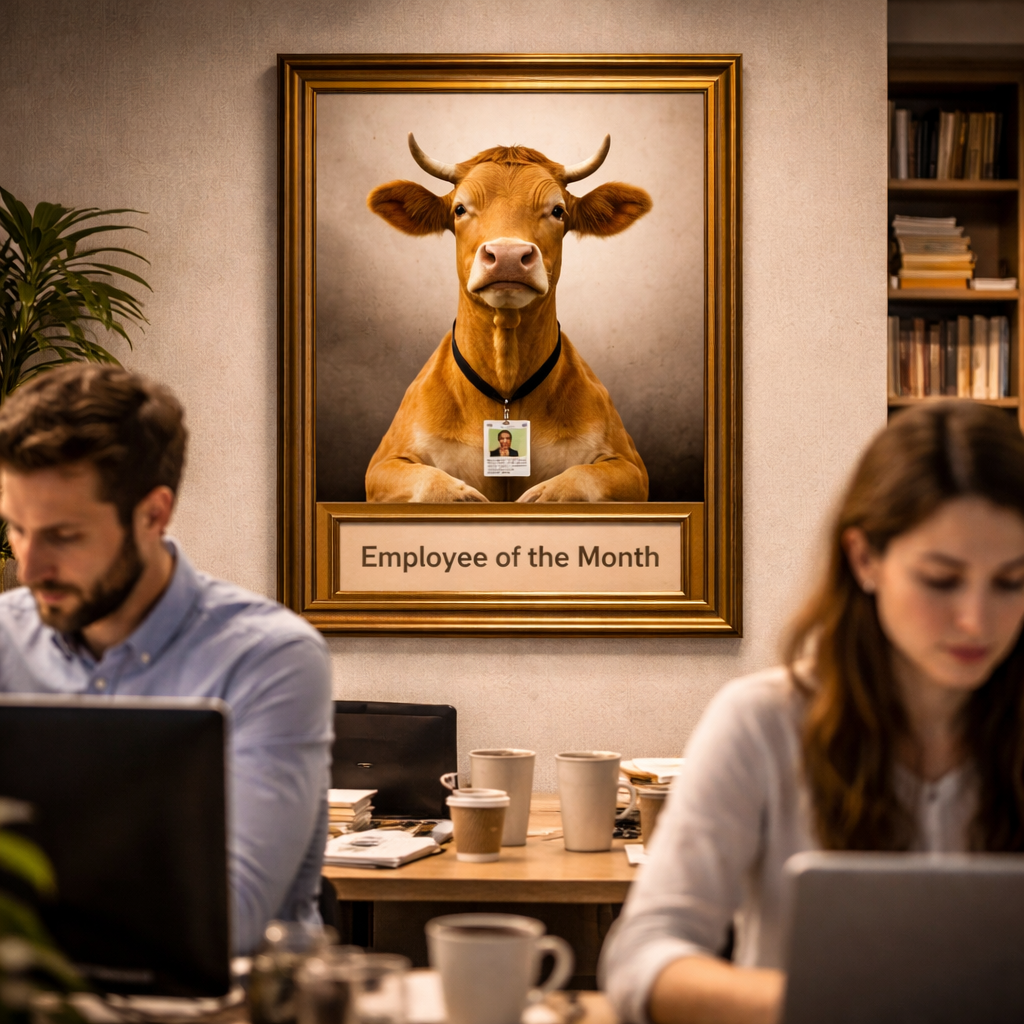
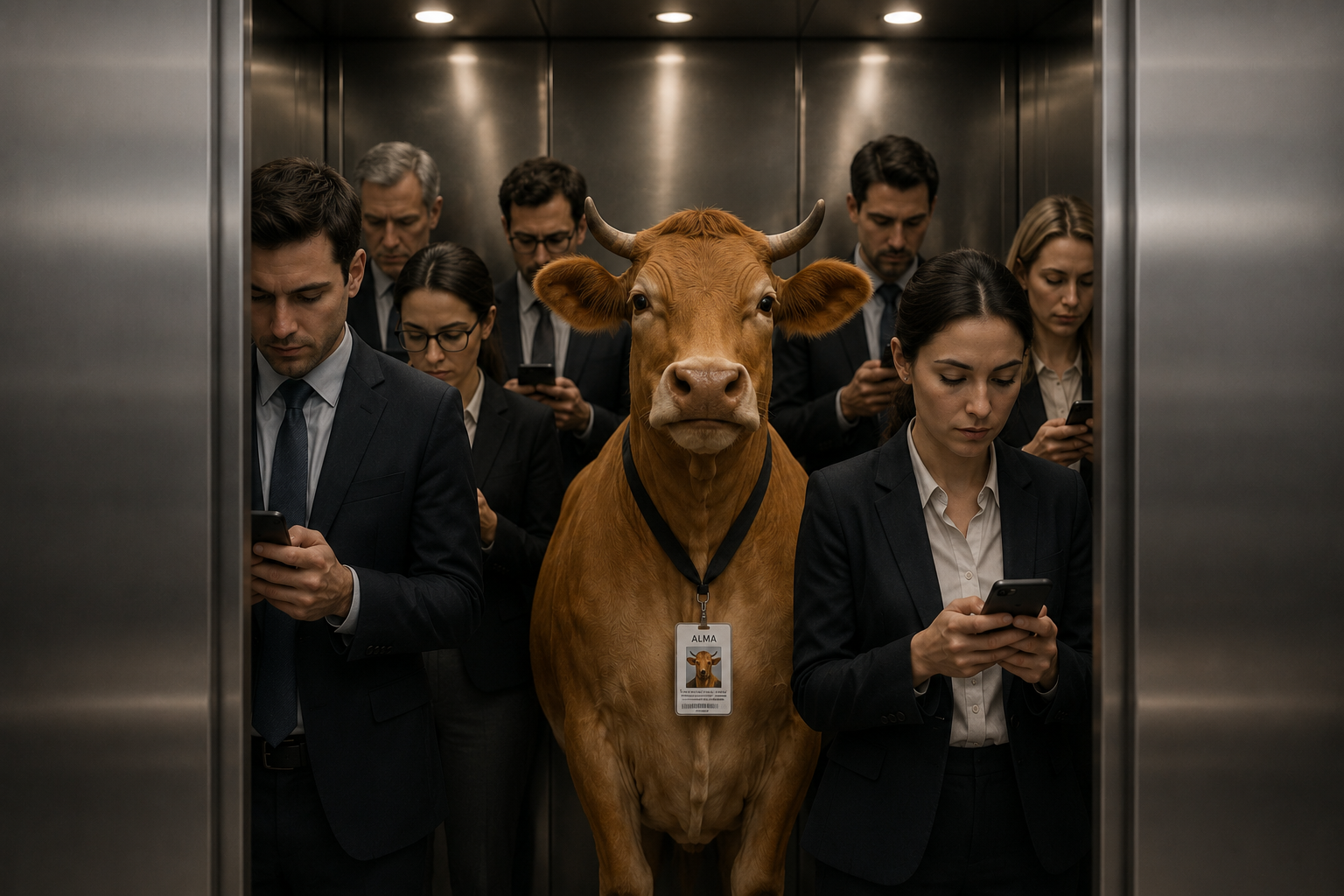
Alma's World is my ongoing satirical project about work, productivity and modern life, observed by a brown cow living in Barcelona.
About the author
Carsten Jan Weichelt is a writer and content strategist based in Barcelona. He writes about AI and writing, content strategy, modern work and the strange systems people build and then somehow end up taking very seriously. Alma's World is his ongoing workplace satire, seen through the eyes of a cow.
Remote work promises freedom: work from anywhere, live anywhere, be anywhere. Cow Alma watches Barcelona's laptop crowd and discovers that freedom apparently still needs Wi-Fi.